Of all the stages of site preparation, grading and leveling may be the most technically demanding and the most consequential for long-term outcomes. Get grading right, and everything built on top of it whether a building, a paved surface, a parking lot, or a landscaped yard performs as intended for decades. Get it wrong, and the problems created will surface repeatedly, in the form of water damage, structural settlement, drainage failures, and surface deterioration.
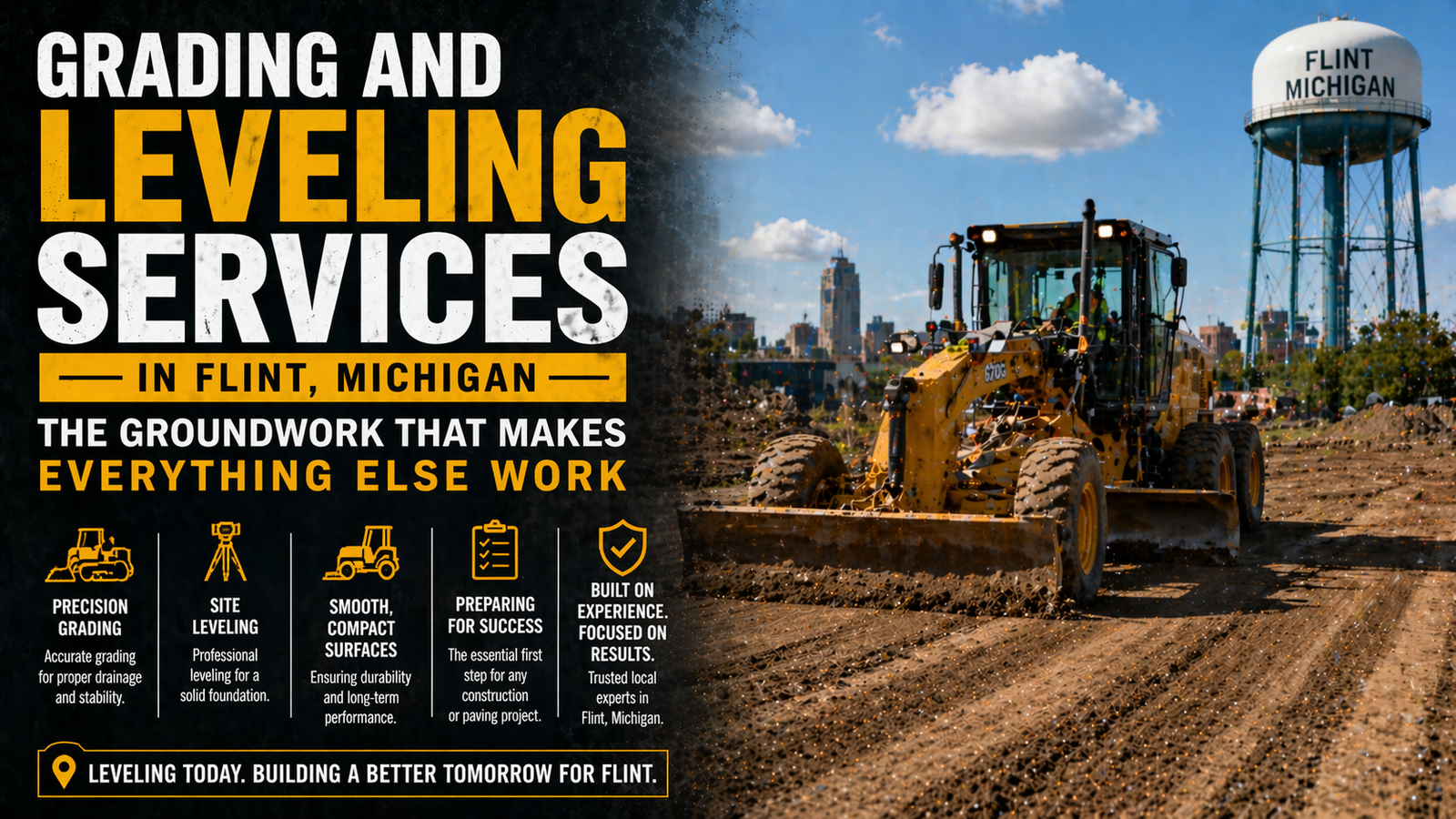
In Flint, Michigan, where soil conditions, seasonal precipitation, and freeze-thaw cycles all create specific challenges, professional grading and leveling services are not a step to be rushed or skimped on. This article explains what Reliable Grading And Leveling Services Flint involve, why they matter in this region, and what distinguishes quality work in this field.
Understanding the Difference: Grading vs. Leveling
The terms grading and leveling are often used interchangeably, but they describe related and sometimes distinct processes.
Leveling refers to achieving a flat, uniform surface across an area. It involves moving soil from high points to low points until the surface is consistent at the same elevation across the target area. True leveling making something perfectly flat is the goal in specific applications such as the sub-base beneath a concrete slab or the surface within a building’s interior.
Grading is a broader term that refers to shaping the surface of the earth to a designed elevation and slope. Grading does not always mean making something flat. In fact, for outdoor surfaces, perfectly flat grading would be a problem, because water would have nowhere to drain. Grading for construction sites, driveways, parking lots, and yards involves establishing precise slopes typically measured in percentage of fall over horizontal distance that direct water away from structures and toward suitable drainage outlets.
Both processes use similar equipment and skills, but the engineering intent behind each is different. An experienced contractor understands when to level, when to grade for drainage, and how to achieve the finished result the project requires.
Why Grading and Leveling Are So Critical in Flint
The geological character of the Flint area makes grading precision particularly important. As noted in excavation contexts, Genesee County soils contain significant clay content in many locations. Clay’s tendency to swell when saturated and shrink when dry means that poorly graded sites where water collects against foundations or beneath paved surfaces experience greater soil movement than sites with effective drainage.
Michigan’s climate amplifies this problem. Annual precipitation in the Flint area averages around 30 to 32 inches, distributed relatively evenly across the year. Winter brings snow accumulation followed by spring melt, which concentrates significant water across the ground surface over a short period. Without properly graded surfaces directing this water away from structures and off paved areas, spring melt becomes a major driver of damage to foundations, driveways, and parking lots.
Freeze-thaw cycles in Michigan where temperatures repeatedly cross the freezing point during late autumn and early spring cause water trapped beneath or within surfaces to expand as ice, then contract when it thaws. This cyclical expansion and contraction is one of the primary forces behind frost heave in foundations, pothole formation in paved surfaces, and cracking in concrete. Proper grading that keeps water moving rather than collecting is the most effective single measure against freeze-thaw damage.
Rough Grading vs. Finish Grading
Professional grading work typically occurs in two distinct phases:
Rough Grading takes place early in the site preparation process, often immediately following site clearing and initial excavation. In rough grading, large volumes of soil are moved to establish the approximate elevations and contours specified by the site plan. Cut areas where soil is removed to lower the elevation and fill areas where soil is added to raise the elevation are established during rough grading. The resulting surface is close to the target grades but not yet refined.
Finish Grading is the precision work that follows. Using motor graders, laser-guided equipment, and careful hand work, finish grading brings the surface to within tight tolerances of the designed elevations and slopes. This is what directly contacts or supports the material that follows whether that is a concrete slab, an asphalt base course, topsoil for landscaping, or a building’s foundation system.
For many projects in Flint, finish grading involves not just shaping the bulk of the site but also carefully transitioning between the new construction and adjacent existing surfaces neighbouring properties, public sidewalks, street curbs, and utility access points.
Laser and Technology-Assisted Grading
Modern grading work increasingly uses technology to achieve precision that would be difficult or impossible with equipment and eye alone. Laser-guided grading systems use a transmitting laser unit to establish a precise reference plane across the work area. A receiver mounted on the grading equipment detects the laser signal and automatically adjusts the blade height to maintain the designed grade as the machine moves across the site.
GPS-guided grading systems take this further, using satellite positioning to guide equipment according to a three-dimensional site design model. These systems are particularly valuable on large or complex sites where multiple grade transitions must be managed simultaneously.
The practical benefit of these technologies for property owners is higher accuracy and fewer errors, which translates to drainage systems that work as designed and surfaces that perform as intended. On smaller residential sites, experienced operators using conventional laser levels and stringlines can achieve comparable precision.
Grading for Drainage: The Most Critical Application
Of all the purposes that grading serves, drainage management is arguably the most important for properties in Flint. The basic principle is straightforward: finished grades around structures should direct water away from the building at a minimum slope of about 6 inches of fall over the first 10 feet from the foundation. Beyond that immediate perimeter, the site grading should continue to move water toward appropriate outlets storm drains, swales, retention areas, or municipal infrastructure.
Common grading problems that arise when this principle is not followed include:
Water pooling against foundation walls, which over time seeps through foundation materials and causes basement moisture, mould, and structural damage.
Water collecting on paved surfaces, accelerating surface deterioration and creating safety hazards in winter when it freezes.
Water migrating toward neighbouring properties, which can create liability issues and neighbourly disputes.
Water saturating lawn areas near the house, killing grass and creating muddy conditions that erode over time.
Correcting poorly graded sites after construction is complete is significantly more difficult and expensive than getting it right during the initial site preparation phase.
Grading for Paved Surfaces
When grading is performed specifically in preparation for an asphalt or concrete surface, the standards become even more precise. The compacted aggregate base beneath a paved surface must be graded to very tight tolerances typically within a quarter inch of the design grade to ensure the paved surface above it will have consistent thickness and proper drainage slope throughout.
In the Flint area, where asphalt driveways, parking lots, and access roads must withstand significant freeze-thaw activity, a properly graded and compacted base is essential. The base prevents differential settlement where different parts of the pavement sink at different rates which is a primary cause of cracking and surface failure.
Grading and Fill Compaction
Where fill soil is used to raise the elevation of an area, that fill must be compacted in controlled lifts layers of a specified maximum depth that are compacted before the next layer is added. Uncompacted fill settles significantly over time as the soil particles rearrange under load, causing the surfaces above to sink unevenly.
Michigan construction standards and engineering specifications govern the requirements for fill compaction on most regulated projects. Even on smaller residential projects, following established compaction practices is essential to prevent settlement-related problems in the years after construction.
Conclusion
Grading and leveling services in Flint, Michigan are the technical foundation on which all surface construction depends. From managing the clay-heavy soils and seasonal drainage challenges specific to Genesee County to achieving the precise grades required for stable pavement and dry foundations, professional grading work requires skill, the right equipment, and a thorough understanding of how water, soil, and freeze-thaw cycles interact in Michigan’s environment. For any construction, renovation, or land development project in the Flint area, reliable grading and leveling is where durable results begin.